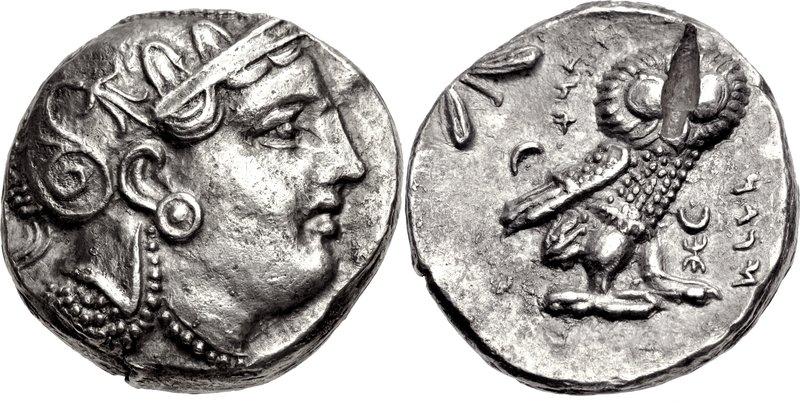
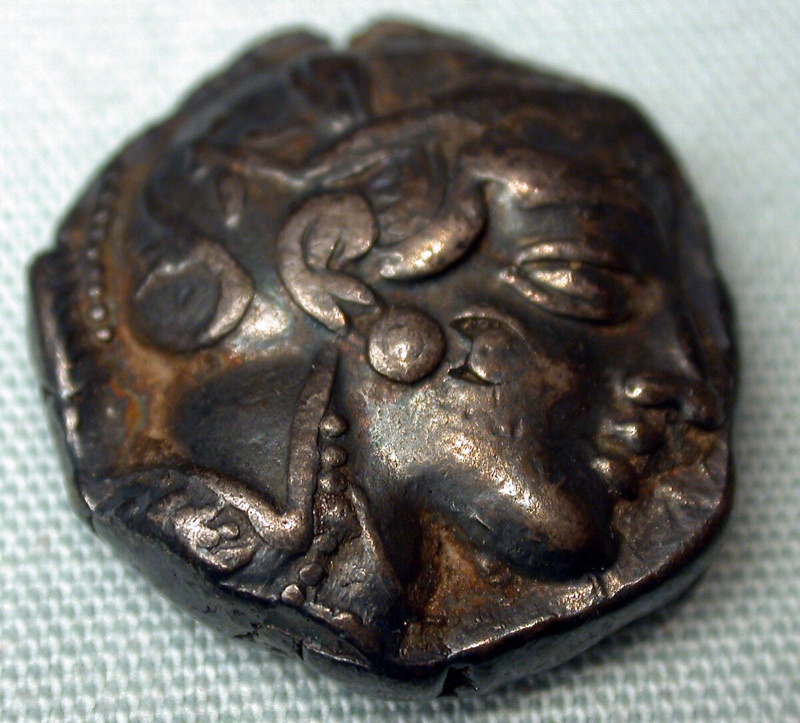
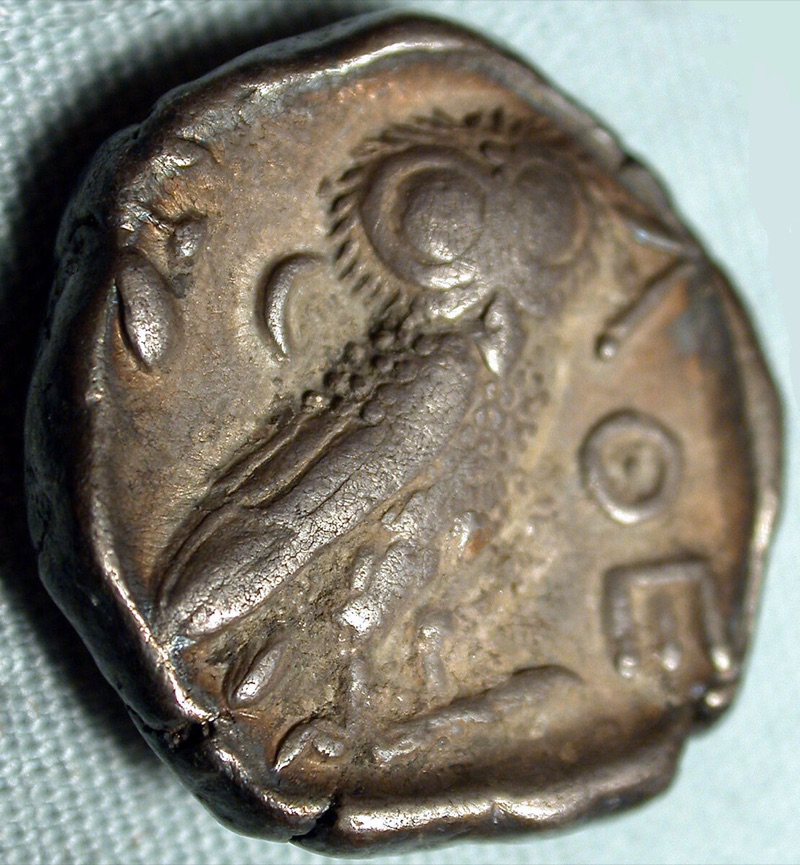
A body in profile. Eyes looking back.
The owl’s body turns right while its head faces the viewer. 04
RESEARCH EDITION 03 / 2026
Athens had silver mines at Laurion, and an owl design whose basic form it saw little need to change until it stopped striking tetradrachms altogether. 11 43 In 408/7 BC one owl was about four days’ pay for a craftsman on the Acropolis. 42
Owl · reverse Athenian tetradrachm · Cleveland Museum of Art 03
In 414 BC Aristophanes had a chorus of birds promise the judges owls of Laurion that would nest in their purses and hatch small change. 44 Athens is a city in Attica, and Attica held Laurion — the silver-mining district behind the city’s coinage. 05 11
An inscribed fourth-century lease record names mines, boundaries, workshops and a furnace: the owl belonged to an economic landscape, not only to an engraver’s bench. A 2025 isotope study argues against a neat “new silver, therefore new design” story. 11 06
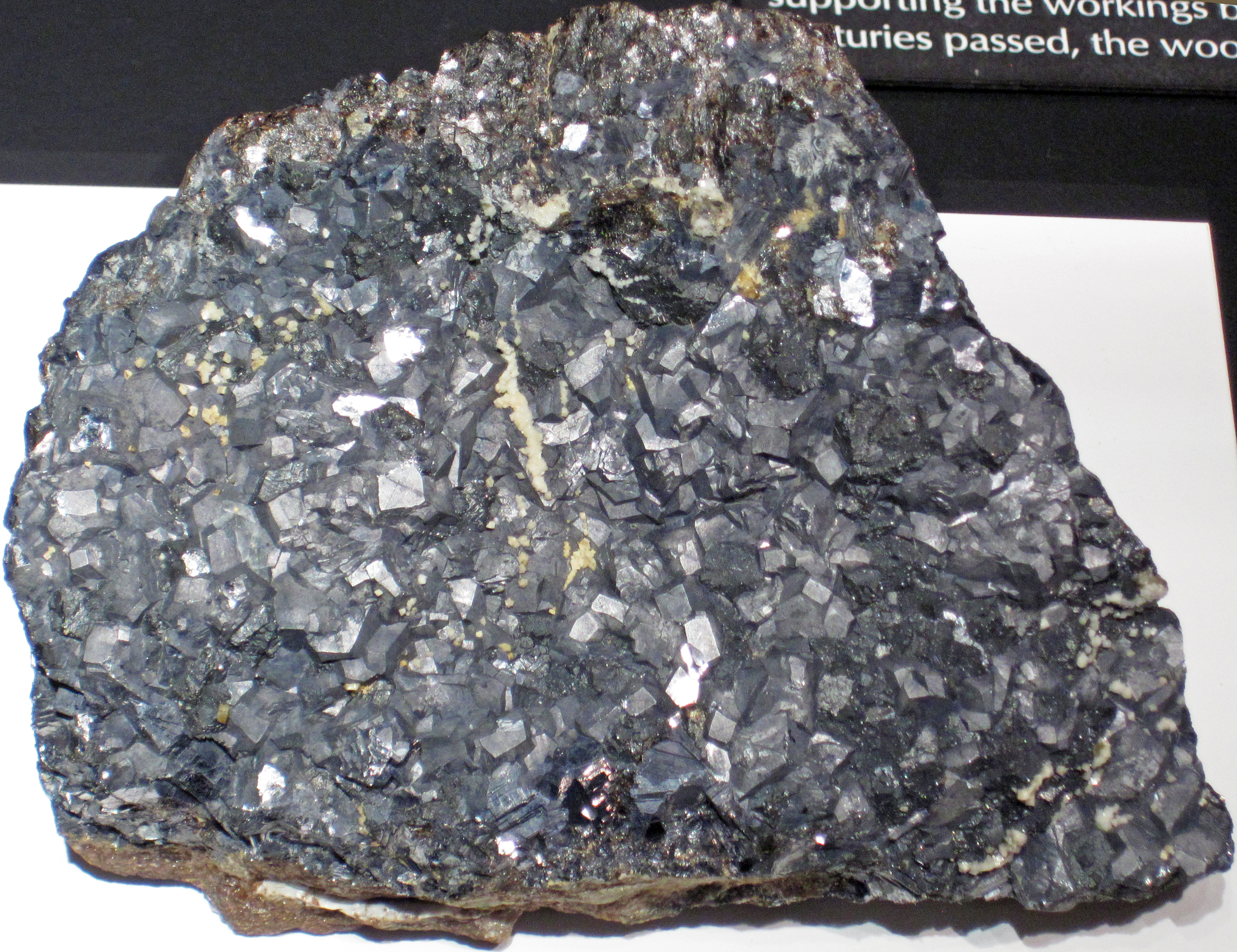
The silver came out of lead ore. Smelting gave lead holding, most often, about two kilograms of silver to the tonne; cupellation, a second firing under blown air, then oxidised that lead to litharge and left the silver behind. 51 What Athens struck from it was the tetradrachm, worth four drachmas, and it was used far beyond Attica. 01 04 29
Ore from the Laurion mines: galena, the lead mineral silver was recovered from. A museum specimen photographed in 2011, not an ancient find.
The pictures began in the tools. Two engraved dies pressed a design into each side of a silver blank. 32
A die is a metal tool with an engraved design. The lower die makes Athena; the upper die makes her owl.
The blank, called a flan, sits on the lower die fixed in the anvil. The upper die goes above it.
A hammer blow drives the silver against both engraved surfaces, impressing the two faces of the coin together.
Athens struck heraldic coins, the Wappenmünzen, before it adopted Athena and her owl. When the city changed, and why, remain research questions. 06
See the earliest owls in the atlasThe owl on the last Athenian tetradrachms, struck in the first century BC, still kept the basic type of the first, though style and detail changed considerably. 43 By the mid-fifth century BCE, Athens was producing the great classical mass issues: the compact Athena–owl design at the heart of this story. 21
Two faces of the same specimen · The Met, 2021.40.80 · 24 mm 01
Choose a face, then a detail. The photographs are the two sides of Cleveland 1941.296; open either to inspect the real surface. 03
Owl / reverse · 4 details
The owl’s body turns right while its head faces the viewer. 04
The olive sprig and crescent accompany the owl on these classical examples. Their presence is observable; a precise commemorative meaning for every detail should not be assumed. 02
The reverse sits in a recessed, or incuse, square formed in striking. The minting illustration earlier in the story shows the blow that forms it. 04
ΑΘΕ abbreviates “of the Athenians.” On this coin theta is a circle with a central dot, the ancient counterpart of the printed Θ, and the form this atlas borrows for its own mark. 04 41
Markers identify approximate areas, not measured die features.
Athena / obverse · 2 details
The conspicuous almond-shaped eye appears almost frontal although Athena’s face is in profile, a convention already set on the archaic owls of c. 520–510 BCE. In many fourth-century issues the eye follows the face into profile. Eye shapes overlap across the late fifth and early fourth centuries, so this feature alone cannot date a coin. 03 17 08 09
The classical helmet here is the reference for what changes next. A developed ornament resembling the Greek letter π names the mid–late fourth-century Pi-style family, catalogued on the BnF specimen shown in the atlas. 07 22
Markers identify approximate areas, not measured die features.
When the fleet sailed for Sicily in 415 BC, the treasury paid each seaman a drachma a day, and the trierarchs added bounties on top. 50 In 404 BCE, Athens surrendered to Sparta. The Peloponnesian War ended, marking a rupture in the history of the city and its coinage. 21
This is the conventional endpoint of the great late-fifth-century mass issue. Older coins continued to circulate, and Athenian coinage continued into the fourth century. 21 08
With New Style, the owl’s surroundings change as much as the bird itself.
A more elaborate helmet transforms Athena’s portrait. On the reverse, the compact classical composition gives way to a broader field filled with objects and inscriptions. 19
A vessel now sits beneath the owl.
The reverse is enclosed by olive leaves.
Names and symbols join the civic inscription. 19
In the fourth century BCE, alongside the changes in Athens, other authorities were making owls of their own.
A 2025 survey of 999 hoards found Athenian coins as far away as the Levant, Egypt, Iran and Afghanistan. 29 Egypt offers a documented example.
The Athena–owl issues attributed to Sabakes belong to Persian-administered Egypt, around 340–333 BCE. IRIS catalogues them as an Egyptian type. 13
Local inscriptions on some southern Levantine issues offer another clue to their issuing communities. Other attributions are disputed. 09
Here, “imitation” means adapting another issuer’s design. Such ancient local coinages are a different category from plated counterfeits or modern forgeries. 10 13
Sabakes type · obverse and reverse.
Where a coin was made, where it travelled and where it was found are three different claims. Each close-up below shows one area; the locator beside it keeps that area in the wider world.
The authority and place that issued a coin. An owl design alone does not prove an Athenian origin. 13 09
Coins could move as money or as silver valued by weight. The same weight standard could also be used by different issuers. 30 01 03 13
A hoard is a group of coins deposited together. Its location records one point in those coins’ histories, not every stop or a complete trade route. 29 30
The modern region helps locate Attica; its borders are not a reconstruction of the ancient city-state.Each view has its own approximate scale. North is always up.
Athens is a city in Attica, the surrounding region on the Greek mainland. Both are in present-day Greece.
The starting point: the Aegean world.
Athens issued silver tetradrachms—coins worth four drachmas. Attica also contained the Laurion silver-mining district, introduced in chapter 01. 05 04 01 11
Sicily is part of present-day Italy. The highlighted island is a geographic reference, not an ancient political boundary.Each view has its own approximate scale. North is always up.
Sicily is the large island just off the “toe” of Italy. It lies west of Greece, in the central Mediterranean.
West of Athens.
Athenian owls occur in Sicilian hoards. These finds document coins reaching the island; they do not make Sicily an Athenian mint. 30
The outline is for orientation; the ancient region and its political divisions changed over time.Each view has its own approximate scale. North is always up.
Anatolia is the large peninsula east of the Aegean Sea, forming the Asian part of present-day Türkiye. Greece faces it across the water.
East of Athens, across the Aegean.
The modern country outline locates Egypt. It is not a map of a particular ancient kingdom or the distribution of coin finds.Each view has its own approximate scale. North is always up.
Egypt lies on the southern shore of the Mediterranean. The Nile runs north through it to a broad delta on the coast.
South of Athens, across the Mediterranean.
The hatched countries locate the broad region. They do not define a single ancient state or an exact historical boundary.Each view has its own approximate scale. North is always up.
The Levant is a regional name for the eastern Mediterranean lands. It includes areas now in Syria, Lebanon, Israel, Palestine and Jordan; its extent varies with context.
Southeast of Anatolia; northeast of Egypt.
Athenian coins reached the Levant, and related owl-type issues also circulated there. Some coins once called eastern imitations have been reassessed as Athenian; a findspot alone cannot settle the mint. 29 09
The hatched area is an approximate locator, not an ancient border. Blue lines show the Tigris and Euphrates.Each view has its own approximate scale. North is always up.
Babylonia was in southern Mesopotamia, in what is now southern Iraq. The Tigris and Euphrates cross this lowland toward the Persian Gulf. Babylon was a city within it.
Inland, east of the Levant.
Oxford’s IRIS catalogue attributes a Mazaces Athena–owl type to Babylon. This is evidence for a related local coinage, not another name for the Athenian mint. 31
The two highlighted country outlines are modern geographic references. No route or exact findspot is implied.Each view has its own approximate scale. North is always up.
Iran lies east of Iraq. Afghanistan lies farther east, beyond Iran. These are two distinct countries, far inland from the Aegean starting point.
Beyond Mesopotamia, east of Athens.
Modern outlines orient the peninsula. They are not the boundaries of an ancient Arabian state or a complete record of mint sites.Each view has its own approximate scale. North is always up.
The Arabian Peninsula lies between the Red Sea and the Persian Gulf. Arabia is a wider geographic and historical name, not simply another name for modern Saudi Arabia.
Southeast of the Levant; south of Mesopotamia.
Arabian authorities also adopted owl-type designs. This edition marks that wider tradition while leaving a fuller account of Arabian series in the coverage register. 29
Selected places across several centuries, not a reconstructed journey or a complete mint map. Modern geographic outlines and rivers: Natural Earth · public domain. Ancient political borders are not shown.
Eye, helmet, lettering, owl, flan. No single feature decides. 08
An excavation records a deposit; a market coin may have none. 09
Lead isotopes can narrow a silver source, never settle it. 06
Laws, leases and accounts record how the money was handled. 10 11 12
Nikophon’s law of 375/4 BCE put a public approver among the bankers’ tables in the Agora. A coin with a bronze or lead core was to be cut through at once, and then became sacred property of the Mother of the Gods, deposited with the Council. A separate clause on foreign owl-type silver survives only in a debated restoration. 10
Read the translated inscriptionThe Erechtheion’s builders earned a drachma a day in 408/7 BC; seven classical owls graded Choice XF sold in 2026 for a median of $1,067.50. 42 33 34 The design is familiar. The prices vary widely. Our 45 auction results from 2026 span $420 to $6,710—different coin families, surfaces and strikes, each with its own appeal.
Good Very Fine, with a worn obverse die. One auction result.
See this saleSeven owls graded Choice Extremely Fine. A comparison group, not a fixed price.
Compare recent salesVery Fine, with a flan flaw and low weight. One auction result.
See this saleSelected 2026 sales · USD including buyer premium, before tax and shipping. This is the span of our sample, not the limits of the market or a valuation of the museum coins shown here.