← Back to the atlas

ONE COIN · A VERY LONG LIFE

2,400 years.
Still here.

Made in ancient Athens. Still graded Mint State. How does a small piece of silver survive that much time?

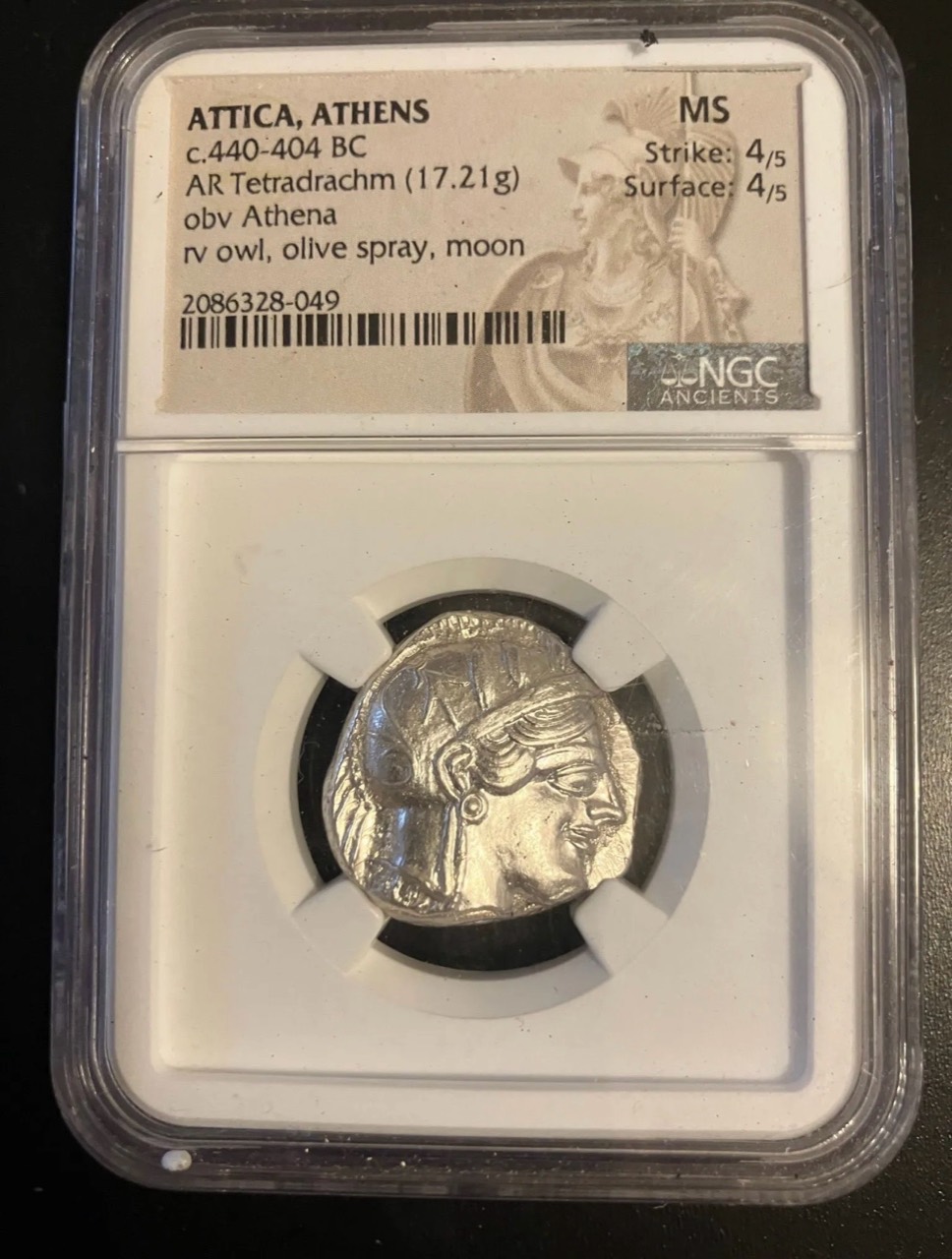
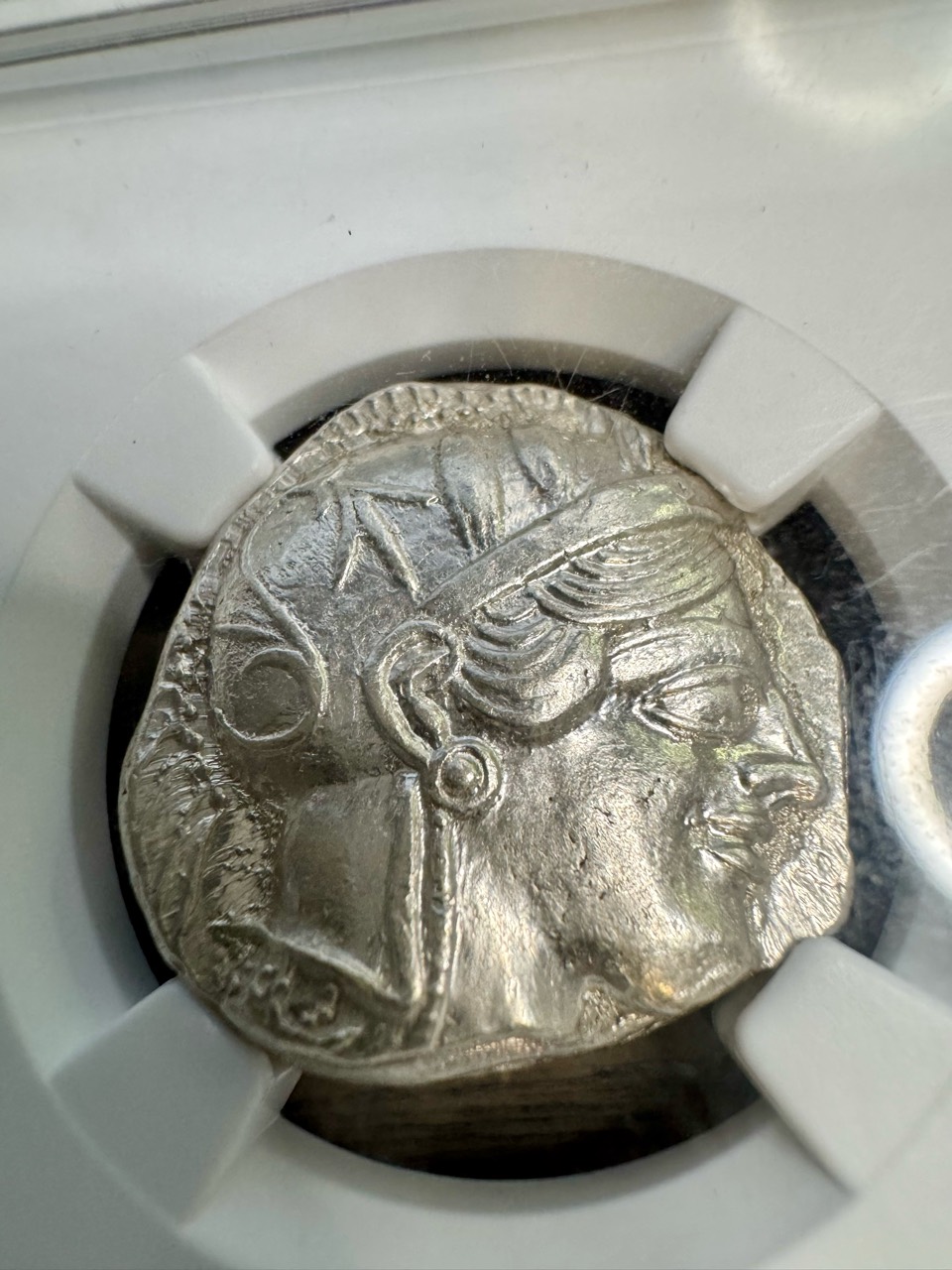
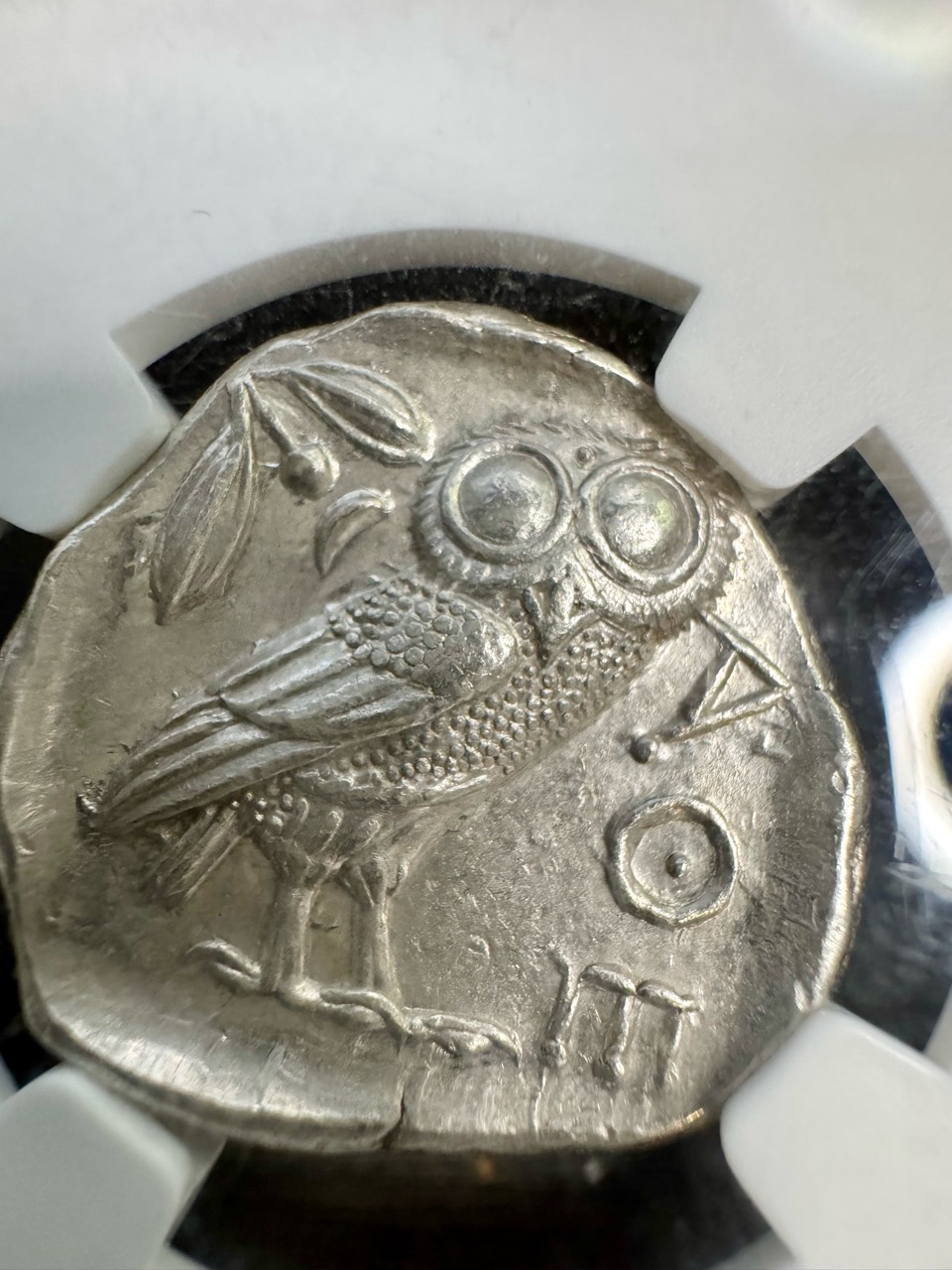
Look at Athena’s hair, the owl’s feathers, the tiny dot inside the theta. These are photographs of one surviving coin. Its details are close enough to study; most of its history is out of reach.

Begin with what survives

Athens · silver tetradrachm
c. 440–404 BCE · 17.21 g

MS · Strike 4/5 · Surface 4/5
NGC 2086328-049 [42]

See the holder & photo record
01 / A MOMENT AT THE MINT

The strike took
a moment.

The sharpness began with a hammer blow. Keeping it is a different story.

A silver blank was struck between two engraved dies. Athena and the owl emerged together. The blank’s shape, the dies and the force and alignment of the strike helped determine which details appeared. [32]

MS Mint State
An uncirculated grade. It describes condition, not a record of every time the coin changed hands.
4/5 Strike
A separate assessment of manufacture: the blank, dies, centering and quality of the strike.
4/5 Surface
An assessment of surface condition, including factors such as marks, corrosion, luster and cleaning. It does not mean “80% of the surface survives.”

NGC assesses these aspects separately. Neither MS nor a surface score establishes that a coin was never cleaned. [36]

See how an owl was struck

Did it ever buy anything?

A payment, a gift, money set aside for later: its grade cannot choose between them. We have found no early ownership record for this coin. But we can imagine a life shaped by the ways people have saved, hidden and treasured old money.

Step into one possible story
HISTORICAL FICTION / AN INTERLUDE

The gift
that waited.

An invented life for an owl like this one. The people, dialogue, hiding place, discovery and royal collection below are fictional. The historical parallels follow the story.

Go straight to the evidence
  1. FICTION / THE FIRST GIFT

    “For whatever you need.”

    Before his daughter leaves to begin a household of her own, a father places a silver owl in her palm. Athena’s helmet catches the light. The bird on the other side looks back with its enormous, impossible eyes.

    She has seen owls before. This one is hers.

    There are things she could buy with it. Instead, when she reaches her new home, she puts it away. Other coins will pass through her hands. This one still carries the warmth of a farewell.

  2. FICTION / THE HIDING PLACE

    A plan to come back.

    Years later, the household must leave in a hurry. She puts the owl with a little saved silver in an earthenware pot, lowers it beneath the floor and covers the place again.

    She pauses at the doorway to fix the room in her memory. The corner. The hearth. The distance between them. It will be easy to find.

    Nobody comes back for it.

  3. FICTION / THE LONG SILENCE

    The world goes on overhead.

    The roof falls. Stones from the house become part of another building. The room she remembered disappears.

    Above the buried silver, children grow old. New rulers put new faces on new money. The owl stays still.

    About two thousand years pass. In this pocket of ground, the silver is fortunate: it escapes the severe corrosion that could have consumed its detail. The feather marks remain. So does the tiny dot inside the theta. No one has been there to admire either.

  4. FICTION / THE SECOND GIFT

    An owl before a king.

    A spade meets pottery. A broken rim gives way to coins. In the unfamiliar light, the owl looks startlingly awake.

    Eventually, a scholar acquires it. He turns it over and reads the Greek letters. He has spent years learning about the vanished world that made it. Here is a piece of that world small enough to rest on his desk.

    Years later, in a seventeenth-century court, he offers it to a king who keeps ancient coins. A shallow drawer opens. Portraits of emperors lie in little rows. There is room for a goddess and her bird.

    “Athens,” the scholar says.

    The king can learn which city made the coin. He will never know why a woman chose to keep it.

END OF THE FICTION

In this telling, affection saves it from spending, concealment gives it a long pause, and curiosity gives it another life.

Were there really royal coin collectors?
02 / A HUMAN MEASURE OF TIME

A lifetime.
Then another.

About eighty to a hundred generations could fit between its making and today.

Using 25–30 years as an illustrative generation length, the coin’s catalogue date gives that approximate span. This is a way to picture elapsed time, not a count of owners or a family tree.

80–100 generations of elapsed time
Each mark stands for one imagined generation-length of time. Eighty solid marks and twenty faint ones show the rounded range. They do not stand for identified people.

A coin can span all those generations without passing through all those pairs of hands.

How the estimate works

In 2026, c. 440–404 BCE is roughly 2,429–2,465 years ago, allowing for the absence of a year zero. Dividing the shortest span by 30 and the longest by 25 gives about 81–99 generations, rounded here to 80–100. Both the minting date and the length of a generation are ranges; this is an illustration, not a genealogical finding.

03 / THE LONG UNKNOWN

Survival can
be uneventful.

No findspot or ancient chain of ownership has been established for this specimen.

A long interval out of circulation can preserve details that repeated handling would wear away.

Coins with little apparent wear really do emerge from hoards. In his 1933 account of the Beni Hasan find in Egypt, J. Grafton Milne described 54 Athenian-type tetradrachms as exceptionally preserved and apparently uncirculated. These were different coins, and his description predates modern grading. [48]

The Acropolis Museum also records an earlier owl, dated 483–480 BCE, from a hoard found in 1886. A recorded find context gives that coin a chapter of history that ours lacks. [45]

Burial can also damage silver: moisture, salts and the surrounding soil matter. Neither an unbroken line of collectors nor a benign burial can be assumed from an MS grade. The fictional story chooses a fortunate path; the real coin’s early path remains unknown. [46]

BACK TO HISTORY / THE COLLECTING INSTINCT

How long have people
collected coins?

Interest in old coins reaches back at least two thousand years. The Smithsonian associates the recognizable collecting hobby with the Renaissance, while noting possible ancient Roman precedents. [49]

  1. ROMAN ANTIQUITY

    Old coins as presents.

    Suetonius describes Augustus giving old royal coins and foreign money as festive gifts. People could already enjoy a coin for its age or unfamiliarity. This is evidence of appreciation and gifting; it does not establish a modern-style collecting hobby. [47]

  2. THE FOURTEENTH CENTURY

    A poet’s gift to an emperor.

    Petrarch recounts giving treasured Roman gold and silver coins to Charles IV. The portraits were lessons in history: he urged the emperor to emulate the rulers they showed. The attraction of an old coin could be intellectual as well as beautiful. [50]

  3. THE SEVENTEENTH CENTURY

    A king makes time for his collection.

    Louis XIV expanded the royal Cabinet and brought it to Versailles so he could spend time with it daily. The BnF’s department of coins, medals and antiquities grew from that royal collection. Royal collecting is a documented part of this wider story. [51]

These are historical parallels, not former owners of the photographed owl. Its documented modern appearances begin below.

04 / THE RECORD COMES INTO VIEW

A long silence.
Then a number.

2086328-049 links the modern records below. It does not fill the centuries before them.

  1. A recorded grade.

    NGC’s certification record gives this grade date and lists MS, strike 4/5 and surface 4/5. It is a grading date, not a discovery date. [42]

  2. An auction appearance.

    GreatCollections lot 1224867 records the same certificate and 17.21 g weight. Its title says strike 5/5, conflicting with the current NGC record and the holder shown here. That discrepancy does not establish a regrade or a physical change. [43]

  3. The number appears again.

    GreatCollections lot 1594499 records the same certificate, weight and MS 4/5–4/5 assessment. Both auction archives mark their lots sold; the prices require login, so no realized price is reported here. [44]

  4. Today

    Close enough to look.

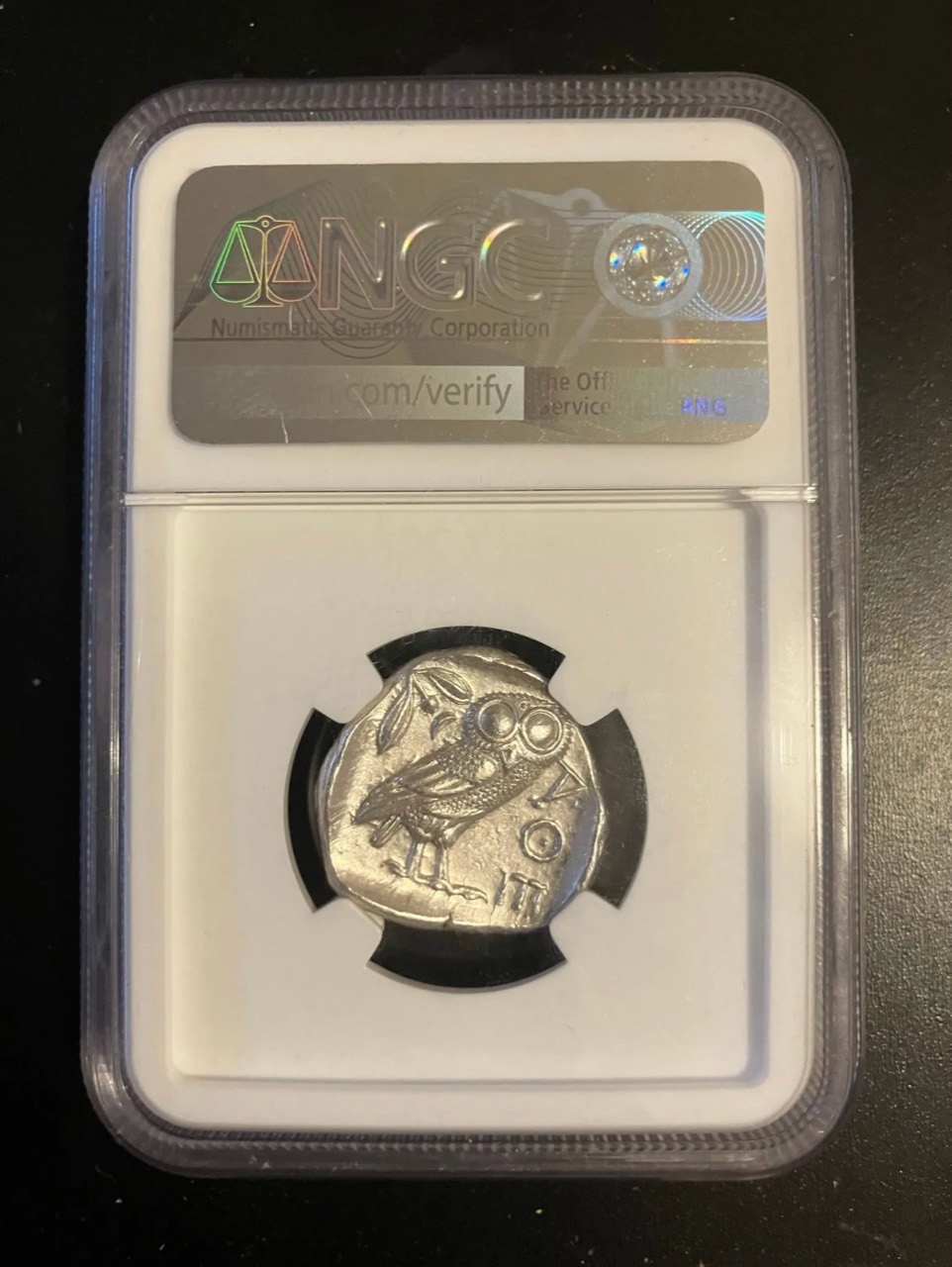
    The present owner supplied these four photographs. They let us connect the coin’s visible details with its holder, while leaving the undocumented parts of its journey open.

Records checked 17 September 2026. Matches are based on the certification number; this is not a complete chain of custody or an independent authentication.

The holder, original photographs & credits

The label reads c. 440–404 BC, AR tetradrachm, 17.21 g, MS, strike 4/5 and surface 4/5. The photographs show the coin through its holder; reflections, prongs and marks on the plastic remain visible.

Photographs courtesy of the owner. Four original JPEGs supplied for this story. No cropping, retouching, reconstruction or enhancement was applied; the viewer opens each complete original. These photographs are included with the owner’s permission for this site and are excluded from the website’s MIT software license. No general reuse license is granted.

The close-ups at the beginning and holder views here depict the same owner-supplied specimen. NGC and auction-house photographs have not been reproduced.

05 / THE NEXT PART OF THE STORY

The next chapter
can have a record.

We cannot recover every hand that held this coin. We can keep its photographs, certification details and sale records together, and preserve the distinction between evidence and a good story.

The next person to wonder how it survived could start with more than we did.

Meet the wider owl family
FOLLOW THE EVIDENCE

A small record.
An honest boundary.

Certification and auction records concern this specimen. Grading, conservation and collecting history provide context for the imagined interlude; they do not document its invented events.

12 sources
32
Museum educational resource

Greek Art: From Prehistoric to Classical — Coins of Ancient Greece

“Origin and Technique,” printed p. 55 (PDF page 57): hand-engraved dies, a lower obverse die fixed in an anvil, a metal blank and an upper reverse die struck with a hammer.

Scope & limitations

The site uses an original schematic to explain this general method. It does not reproduce the publication’s artwork or reconstruct a particular Athenian workshop, tool set, strike count or coin specimen.

36
Reference guide

NGC Ancients: grading, strike, surface and style

Explains adjectival ancient-coin grades, separate strike and surface scores, and the star designation for eye appeal. These categories describe different aspects of a coin.

Scope & limitations

Market research snapshot checked 17 September 2026. Small, selected samples do not establish an appraisal or a market-wide price index. Individual sale records and qualifications are retained in the pricing ledger.

42
Specimen certification record

Certification record: 2086328-049

Records c.440–404 BC, Attica, Athens, AR tetradrachm; MS, strike 4/5, surface 4/5; grade date 12 October 2018.

Scope & limitations

The field titled Pedigree contains a design description, not former owners. The grade date is not a discovery date. Owner-supplied holder photographs corroborate the label; no new authentication is claimed.

43
Auction archive

Auction 1224867 · 2 October 2022

Records certificate 2086328-049 and 17.21 g. Auction ended 2 October 2022 and is marked sold.

Scope & limitations

Its title states strike 5/5, conflicting with the current NGC record, supplied holder photograph and 2024 listing. This inconsistency does not establish a regrade. Price requires login and is not reported here.

44
Auction archive

Auction 1594499 · 9 June 2024

Records certificate 2086328-049, 17.21 g, MS, strike 4/5 and surface 4/5. Auction ended 9 June 2024 and is marked sold.

Scope & limitations

The certification number links the record to the specimen. No buyer, later transfer, invoice settlement or continuous ownership chain is established. Price requires login.

45
Museum object record

Athenian tetradrachm · Acropolis hoard 1886, no. 20

An owl dated 483–480 BC from a hoard found on the Acropolis in 1886. A documented example of a coin with a recorded hoard context.

Scope & limitations

This is an earlier, different specimen. Its findspot and preservation history cannot be transferred to NGC 2086328-049. No museum photograph is reproduced on the companion page.

46
Conservation guidance

Identifying Archaeological Metal · CCI Notes 4/1

Explains how metal and burial environments affect corrosion, including silver corrosion products.

Scope & limitations

General preservation context, not a diagnosis of this specimen or evidence that it was buried.

47
Ancient literary source

Life of Augustus, chapter 75

Describes Augustus giving old royal coins and foreign money as festive gifts. Supports interest in older or unusual coins in antiquity.

Scope & limitations

Does not establish an ancient collector’s involvement in this owl’s survival or an organized modern-style collecting tradition. Translation published in 1913.

48
Published hoard study

The Beni Hasan Coin-Hoard

Journal of Egyptian Archaeology 19 (1933), pp. 119–121. Describes 54 Athenian-type tetradrachms as exceptionally preserved and apparently uncirculated.

Scope & limitations

The opening primary text was checked in an indexed scan; the complete page image could not be retrieved. Historical condition language is not a modern grade. The article considers an Egyptian origin for these pieces; they are not identified as the featured coin or its hoard.

49
Museum history of collecting

Collecting Money · The Value of Money

Places the recognizable collecting hobby in the Renaissance and notes possible ancient Roman precedents.

Scope & limitations

Ancient appreciation and the later organized hobby are distinct. The exhibit does not establish a unique first collector or this specimen’s ownership.

50
Historical letter in translation

His Audience with the Emperor · Familiar Letters XIX.3

Petrarch recounts giving treasured ancient Roman gold and silver coins to Charles IV as examples of rulers to emulate. See pp. 370–376, especially 371–372.

Scope & limitations

The page uses a broad fourteenth-century date to distinguish the 1354 encounter from the 1355 letter. These Roman coins are not the Athenian owl pictured here. No claim that Petrarch was the first collector.

51
Institutional collection history

History of the Department of Coins, Medals and Antiques

Describes Louis XIV expanding the royal Cabinet and moving it to Versailles so he could spend time with it daily; the collection is ancestral to the BnF department.

Scope & limitations

The Cabinet contained antiquities as well as coins. This institutional history supports the royal-collector setting, not any royal ownership of NGC 2086328-049.
THE CLOSE LOOK

Coin photograph

100%
SOURCE NOTE