Classical mass issues
c. 450s–404 BCEAthena, olive, crescent, owl and ΑΘΕ in a familiar, compact design. [01] [21]
Mature fifth-century design
Return to any part of the story with the comparison tool or the eight-family reference below. Pi-style includes both Pi III and Pi II specimens. Photographs are normalized for viewing, not displayed at actual size.
Athena, olive, crescent, owl and ΑΘΕ in a familiar, compact design. [01] [21]
Mature fifth-century design
A broader composition: elaborate Athena, owl on an amphora, olive wreath and more inscriptions. [19] [14] [20]
Late endpoint varies by catalog
Image quality varies by source. The viewer identifies the available pixels and always links to the original record.
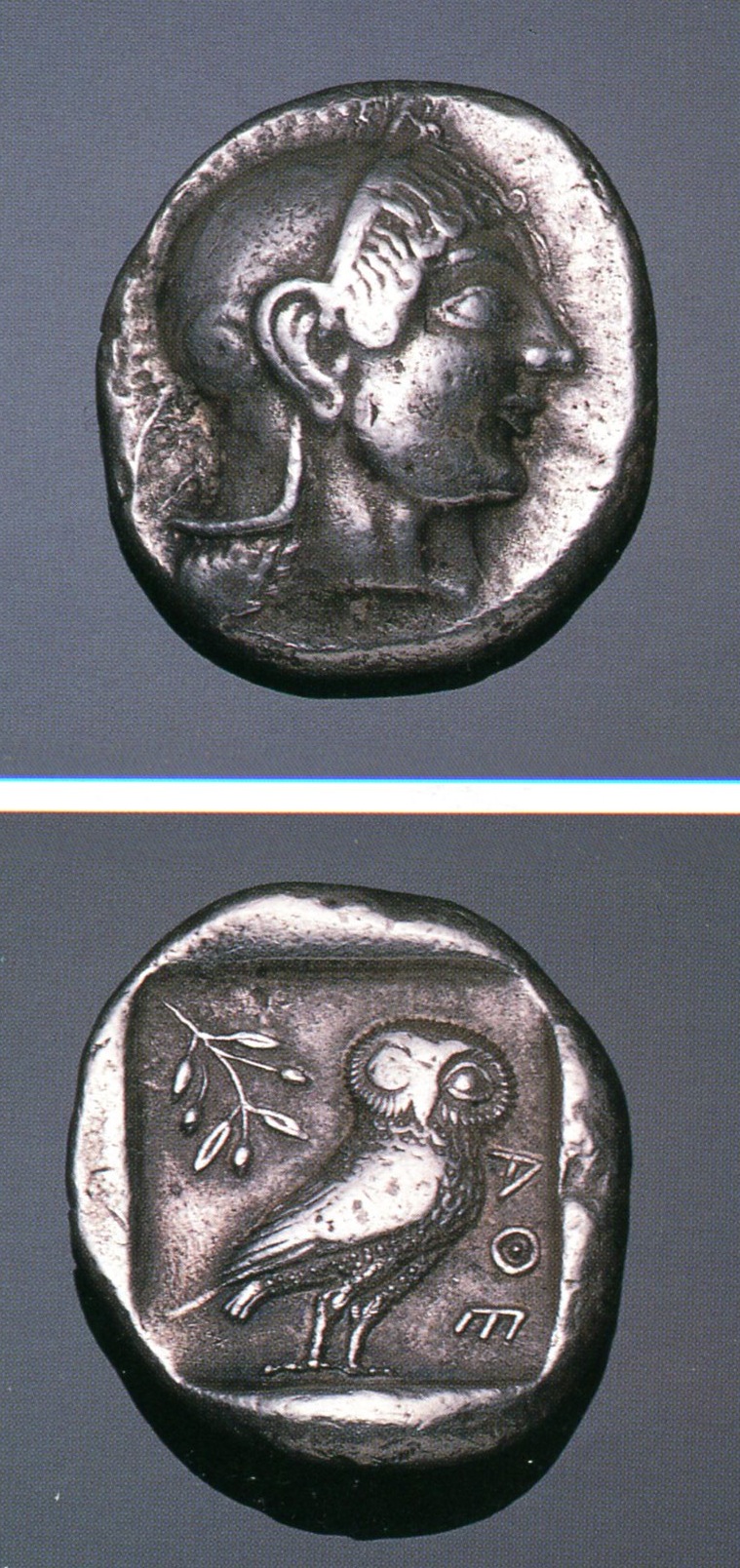
Late 6th century–c. 480 BCE
A strikingly frontal eye on a profile face; compact, individually engraved forms. [17] [06]
Approximate boundary
The Athena–owl pairing was already established before the classical mass issues. Early style varies: “archaic” is not a synonym for crude. The exact introduction date remains debated.
One archaic VF tetradrachm with a flan flaw sold for $6,710 in January 2026. A single result cannot establish a range for this diverse early family; it does not value the photographed specimen.
USD, including buyer premium; before tax and shipping. Research: 17 September 2026.
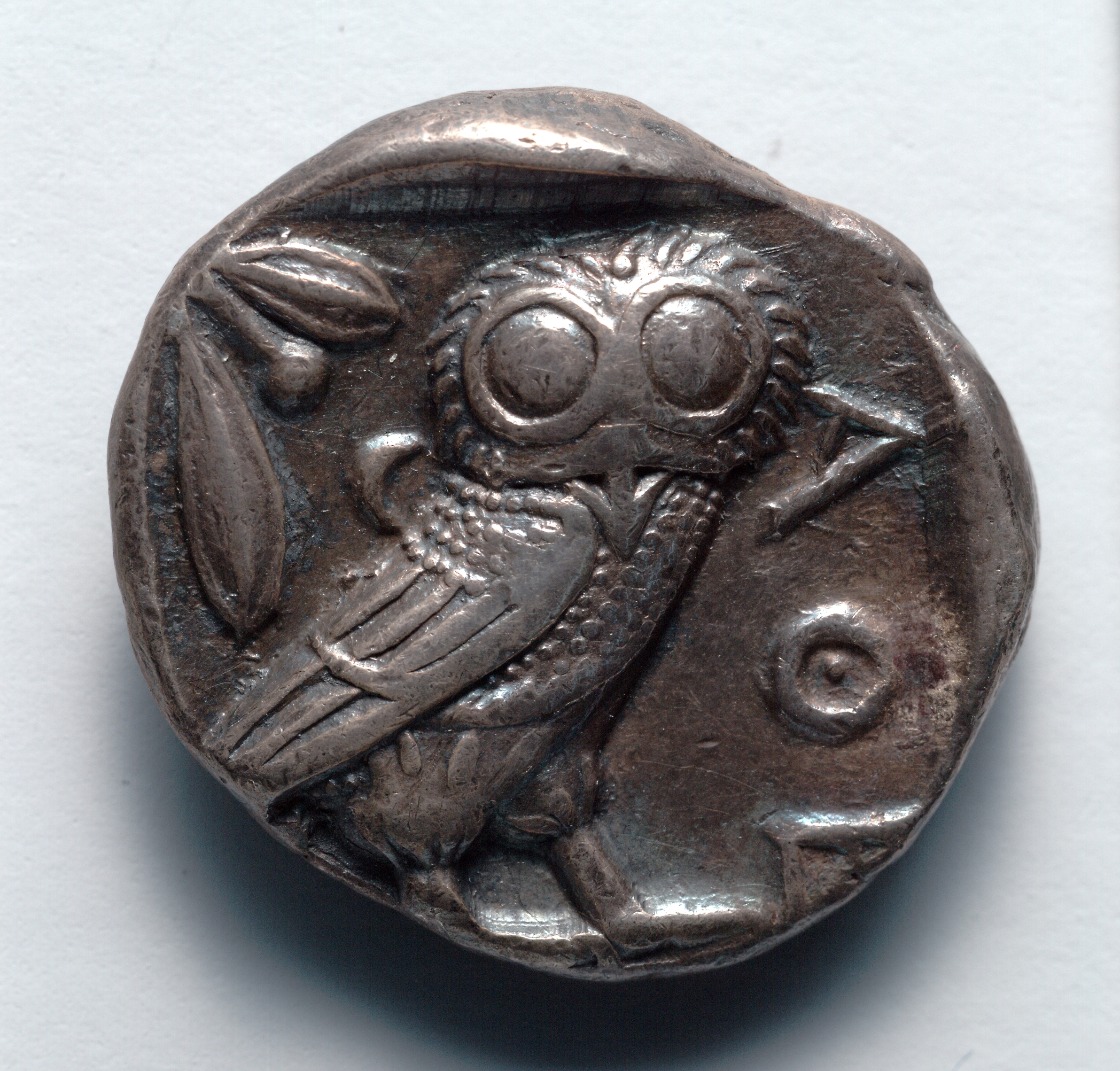
Explore prices & the evidence ↗c. 480–450 BCE
More composed engraving, while the old frontal-eye convention survives. [02]
Broad stylistic grouping
Sometimes called transitional in the fifth-century sense. This label is not the same as the “transitional” owls of the early fourth century. The illustrated museum example is dated 480–449 BCE. Both photographs show the same coin: Cleveland 1920.267, with obverse 1920.267.a and reverse 1920.267.b.
Different early-classical coins sold for $1,464 (Starr IV, Choice VF with scuffs) and $2,928 (Starr V, Choice AU) in 2026. They are different issues and grades, not a price range for the Cleveland specimen.
USD, including buyer premium; before tax and shipping. Research: 17 September 2026.
Heritage 232616 / 63054 · Heritage 61626 / 23036
Explore prices & the evidence ↗c. 450s–404 BCE
Athena, olive, crescent, owl and ΑΘΕ in a familiar, compact design. [01] [21]
Mature fifth-century design
The mature group dated 440–404 BCE sits within this broader mass-issue phase. The illustrated Met specimen retains its museum catalogue date; the period does not identify a particular year of striking.
Other classical owls graded NGC Choice XF sold for $976–$1,464 in our seven-coin 2026 sample. Centering, strike and surfaces still differ. This is context for the family, not a valuation of the museum coin.
USD, including buyer premium; before tax and shipping. Research: 17 September 2026.
Heritage 232622 / 64024 · Heritage 232635 / 64020
Explore prices & the evidence ↗Early 4th century BCE
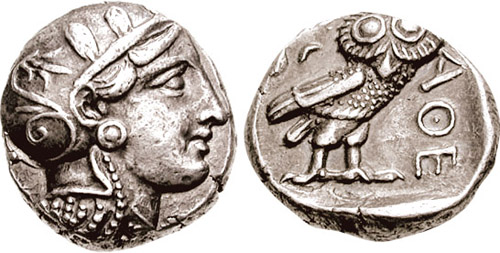
Athena’s eye is more plausibly seen from the side; the reverse remains conservative. [08] [18] [09]
Exact opening date debated
Frequently cataloged c. 393–355 BCE, with other chronologies using c. 400/390–353. Eye shape is a clue, not a universal dating algorithm: related forms occur in late fifth-century work.
Mid–late 4th century BCE
The developed helmet ornament suggests the Greek letter π; many flans show folding and restriking. [07] [09] [22] [24]
Illustrated: Pi III + Pi II · image reuse review pending
The main image is BnF 1966.453.1475, explicitly catalogued as Pi III, c. 353–295 BCE. Pi II, BnF 1966.453.1469, is available in the comparison selector with its broader catalogue date retained. These object dates are distinct from competing wider Pi-style chronologies, including Kroll’s 353 BCE reminting and the early-340s discussion in the 2026 isotope paper.
Other Pi-style coins sold for $420 (raw Good VF, worn obverse die) and $793 (NGC MS) including fees in 2026. The sample cannot establish separate values for Pi II or Pi III, or for these BnF specimens.
USD, including buyer premium; before tax and shipping. Research: 17 September 2026.
CNG 612 / 89 · Heritage 232635 / 64024
Explore prices & the evidence ↗3rd century BCE
The old Athena–owl design persists in distinct groups, including quadridigité and heterogeneous issues. The illustrated specimen is quadridigité. [23] [26] [27]
Illustrated: quadridigité · heterogeneous photo still needed
BnF 1966.453.1478 is explicitly catalogued as quadridigité and dated c. 286–261 BCE in that record; this range is not a date for every later Old Style issue. A separate Heterogeneous Group C auction specimen is sourced, but its 500 × 240 px preview has not been substituted for a high-resolution reference photograph. Reuse review remains pending for the linked BnF photographs.
A quadridigite VF coin with marks and scrapes sold for $570 including fees in July 2026. This is one other specimen, not a valuation of the BnF coin or a price guide to every later Old Style group.
USD, including buyer premium; before tax and shipping. Research: 17 September 2026.
Explore prices & the evidence ↗c. 165/164–1st century BCE
A broader composition: elaborate Athena, owl on an amphora, olive wreath and more inscriptions. [19] [14] [20]
Late endpoint varies by catalog
The familiar c. 165–42 BCE label is not a universally settled pair of endpoints. This atlas uses a broader envelope rather than assigning every New Style coin one precise terminal date.
Other New Style coins sold for $610 (NGC Fine) and $1,464 (Choice XF) in August 2026. Exact issues and condition differ; these examples do not establish magistrate-by-magistrate values or price the museum photographs.
USD, including buyer premium; before tax and shipping. Research: 17 September 2026.
Heritage 61541 / 25003 · Heritage 61541 / 25011
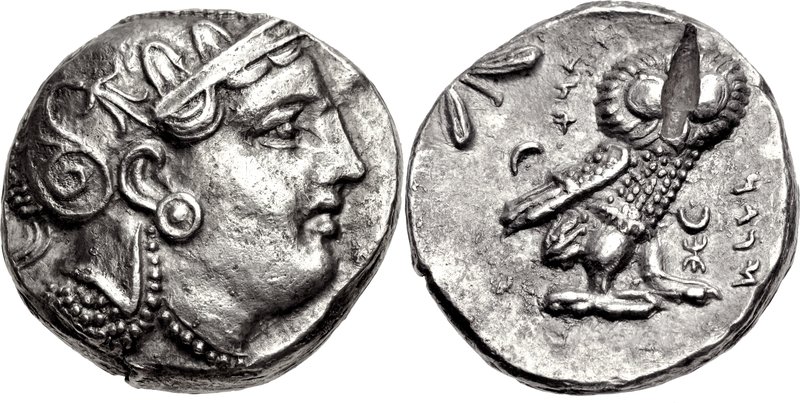
Explore prices & the evidence ↗c. 340–333 BCE · Sabakes type
Athenian visual language adapted under Persian administration in Egypt. [13]
Different issuing authority
“Attic” can describe a weight convention, not the mint. An owl design or an Egyptian findspot alone does not settle who issued a coin. This named type provides a stronger attribution.
Museum and catalogue descriptions bring together place, denomination and attribution. Each answers a different question; none replaces a close look at the object.
The region around Athens in present-day Greece. Athens was the issuing city-state. “Attica, Athens” identifies region and city, not two separate owl varieties. [05]
A weight convention used beyond Athens. The illustrated Cleveland tetradrachm weighs 17.2 g; findspot, weight standard and mint are separate questions. [03] [13]
A denomination of four drachmas. AR in a catalog identifies silver, not a place or a mint mark. [01]
The two faces of a coin. For these Athenian types, the Athena face is conventionally the obverse and the owl face the reverse. [01]
The metal blank that receives the design. Its shape and folded or restruck fabric may preserve evidence of manufacture. [07]
A recessed area. On many older owl reverses, the design lies within an incuse square. [04]
An inscription naming a people or civic community; ΑΘΕ is the abbreviated ethnic of the Athenians. [04]
A modern stylistic label referring to the helmet ornament—not the value, weight, or mathematical properties of the coin. [07]
A coin using another issuer’s design language. An ancient imitation can be real silver and historically legitimate; this is not the same category as a modern forgery. [13] [10]
A deliberate incision used to investigate metal beneath the surface. A cut is evidence to interpret, not proof of a precise route or an automatic guarantee of authenticity. [10] [09]
A hoard is a deposited group of objects; a findspot records discovery. Neither is automatically the place where a coin was minted. [09]
Circa means approximately. BCE uses the same numbered years as BC: 440 BCE and 440 BC refer to the same year.
Browse the research behind the story, check a museum record, or review a photograph’s credit and reuse terms.
Reviewed 16 September 2026. This independently assembled guide covers the major silver-owl families and selected related issues. It is not a complete die catalog, an authentication service, or a museum-endorsed publication. A specialist editorial review remains necessary before presenting it as a definitive reference.
Illustrated: eight main reference families, including Pi III, Pi II and quadridigité specimens.
Still in progress: high-resolution heterogeneous photography and wider subtype coverage. The six BnF photographs are sourced, with image reuse review still pending.
Outside this edition’s full coverage: denomination-by-denomination catalogs, emergency gold and plated issues, bronze, Arabian and other regional series, New Style magistrate sequences, die links and modern forgeries.
The 440–404 BCE catalog range, Athena/owl design, 24 mm diameter, and public-domain images.
The record identifies the museum specimen shown. Its date is a catalogue attribution, not an inscribed year.
The museum’s 480–449 BCE dating, 17.237 g weight, and linked obverse (1920.267.a) and reverse (1920.267.b) records for the same coin.
The current museum range is used instead of a single-year field in the older Commons import. Both side records explicitly identify 1920.267 as their parent accession and are designated CC0.
A 449–440 BCE specimen; 17.2 g, 23 mm; Gift of Dr. Jacob Hirsch.
A single measured specimen is not a universal specification for all owls.
The ΑΘΕ ethnic, olive twig, owl, and incuse square; the Acropolis hoard of 1886.
The geographical distinction between Athens and Attica.
Archaic silver sources; chronology of the Laurion discovery; evidence against a simple one-event origin story.
Archaeological and Anthropological Sciences 17, 122. New analyses of 52 archaic coins plus 12 legacy measurements; the authors’ interpretation is identified as such.
Pi-style, folded flans, reminting, and the proposed 353 BCE fiscal context.
Hesperia 80(2), 229–259. Consulted in the author’s online copy. Later work revisits the date; this atlas does not treat 353 as settled.
Early fourth-century profile-eye coinage, surviving hoards, and reminting as an explanation for rarity.
Revue belge de Numismatique 157, 3–26. Relative classification is more secure than every absolute date.
Three-quarter-eye owls, contested “Eastern imitation” attributions, the 404 BCE endpoint, and revised Pi-style discussion.
Journal of Archaeological Science: Reports 70, 105634. Consulted via the author’s full-text copy on ResearchGate. The paper reports 22 sampled coins; the atlas avoids converting a sample-specific argument into a universal authentication rule.
Official testing, foreign owl-type silver, and bronze- or lead-cored coins.
The restored wording of the foreign-coin clause is uncertain. Its treatment of good foreign silver is not equated here with a blanket legal-tender rule.
Documentary evidence for the mining landscape of Laurion and Sounion.
Treasury payments in talents, drachmas, and fractions of obols for civic, religious, and military purposes.
A securely attributed non-Athenian branch: Egyptian Athena/owl issues under Persian administration, c. 340–333 BCE.
The authority, coin type, and date range are distinct from the findspot of an individual coin.
Specialist chronological debate and the revision of the older New Style chronology.
American Numismatic Society Museum Notes 29, 29–42. Bibliographic record verified; not represented as an independently rechecked die corpus.
Foundational revision of Margaret Thompson’s absolute chronology.
Numismatic Chronicle, 275–300. Listed as a specialist research route; full text was not independently rechecked for this edition.
The Greek €1 national side adapts the owl from a fifth-century Athenian four-drachma coin.
An archaic Athena/owl specimen, 17.09 g, cataloged c. 520–510 BCE; Seltman 302d.
Use the early date as the source’s attribution, not a precise mint year. CC BY 2.0, confirmed by the Commons Flickr review.
Paired obverse/reverse of a specimen cataloged c. 393–355 BCE; 17.12 g; SNG München 90.
The source image is only 500 × 253 pixels. It is labeled as a reference-quality plate, not high-resolution evidence.
The amphora, surrounding wreath, and reverse inscriptions visible on a New Style example.
The file description retains an old c. 200–150 BCE attribution. That metadata is preserved in the credit, not silently adopted as this atlas’s series chronology.
One explicit alternative to the commonly encountered c. 165–42 BCE series envelope.
An annotated commercial reference, not a peer-reviewed authority. Used only to demonstrate divergent catalog date conventions.
The conventional mass-issue range, its 404 BCE historical endpoint, and the main stylistic divisions.
A specialist overview is not a substitute for a die study. Any disputed absolute boundaries are marked separately.
Explicit identification as Pi III; accession 1966.453.1475; SNG France 1, Collection Jean et Marie Delepierre, no. 1475; weight 17.19 g and diameter 21 mm. Catalogue date: c. 353–295 BCE (BnF catalogue, attributed there to Flament). Gallica photographs are tied to this object record.
This is the specimen catalogue’s date range, not an exact issue date and not a claim that all Pi-style chronology is settled. Photograph rights are recorded separately on the individual Commons pages and in BnF’s reuse policy. Institutional attribution does not by itself settle image reuse rights.
Explicit identification as Quadridigité; accession 1966.453.1478; SNG France 1, Collection Jean et Marie Delepierre, no. 1478; weight 17.22 g and diameter 21 mm. Catalogue date: c. 286–261 BCE (BnF catalogue, attributed there to Flament). Gallica photographs are tied to this object record.
The source’s date convention is preserved. Other specialist catalogues may draw different endpoints. Photograph rights are recorded separately on the individual Commons pages and in BnF’s reuse policy. Institutional attribution does not by itself settle image reuse rights.
Explicit identification as Pi II; accession 1966.453.1469; SNG France 1, Collection Jean et Marie Delepierre, no. 1469; weight 17.16 g and diameter 23 mm. Catalogue date: c. 393–295 BCE (broad BnF catalogue range, attributed there to Flament). Gallica photographs are tied to this object record.
Do not silently turn the broad 393–295 BCE record range into the date of Pi II as a whole. The type identification and the chronology should be stored separately. Photograph rights are recorded separately on the individual Commons pages and in BnF’s reuse policy. Institutional attribution does not by itself settle image reuse rights.
Type-level reference for Pi-style Athenian tetradrachms. Links the museum specimen evidence to a wider numismatic classification.
A type-level record is not a precise date for each photographed specimen; the BnF accession records remain the direct evidence for Pi II and Pi III identifications.
Quadridigité type entry linking the BnF specimen 1966.453.1478 to the specialist classification.
Quadridigité illustrates one later Old Style group; it is not a generic name for every third-century Athenian owl.
Catalogues a 17.13 g, 24.5 mm coin as Heterogeneous Group C, c. 280/67–229 BCE, with a reference to Nicolet-Pierre and Kroll, Group C, no. 1 (same dies).
“Same dies” is the auctioneer’s die-match attribution, not a statement that this is the same physical specimen as the published reference. Only a 500 × 240 px paired preview was located. No image from this lot is embedded in the atlas; a higher-resolution original and reuse review remain outstanding.
BnF’s published conditions for commercial and promotional reuse of reproductions, with stated exceptions. Preserved alongside the individual Commons PD-France assertions.
The atlas does not resolve their application to every project or jurisdiction. Six linked photographs of BnF specimens remain marked “Reuse review pending”; no permission request has been sent, and no CC0 grant is asserted.
Hoard-based distribution of Classical Greek coinages, including Athenian coins in Egypt, the Levant, Mesopotamia, Iran and Afghanistan, and discussion of foreign imitations.
The sample covers 550–300 BCE, not every period or every find. Some older hoard descriptions combine Athens and imitations. Hoard locations do not reconstruct exact trade routes; use, issuing intent and movement mechanisms remain interpretive questions.
Published hoard evidence for Athenian coins in Sicily, southwest Anatolia, Egypt, the Levant and farther east; discussion of coins used as bullion.
A historical synthesis retained for its documented geographic examples. Its chronology and broad attribution arguments are not automatically adopted; later research, including Gentelli et al. (2026), revisits some eastern imitations. This overview is not a complete gazetteer of finds.
An Athena–owl type attributed to Mazaces and the mint of Babylon, in Babylonia.
IRIS gives this type a broad 350–300 BCE range. The geographic introduction uses the mint attribution; it does not extend this date range to every Babylonian owl-type coin or imply an exact issue date. No new specimen photograph is embedded.
“Origin and Technique,” printed p. 55 (PDF page 57): hand-engraved dies, a lower obverse die fixed in an anvil, a metal blank and an upper reverse die struck with a hammer.
The site uses an original schematic to explain this general method. It does not reproduce the publication’s artwork or reconstruct a particular Athenian workshop, tool set, strike count or coin specimen.
Lots 64014–64025, auction 232622. Twelve consecutive classical mass-issue tetradrachms; reported realized prices include buyer premium.
Market research snapshot checked 17 September 2026. Small, selected samples do not establish an appraisal or a market-wide price index. Individual sale records and qualifications are retained in the pricing ledger.
Lots 64008–64023 supply sixteen classical examples; lots 64024–64025 are separate Pi-style comparisons. Archive dates are auction end dates.
Market research snapshot checked 17 September 2026. Small, selected samples do not establish an appraisal or a market-wide price index. Individual sale records and qualifications are retained in the pricing ledger.
15 July 2026: a Good VF classical tetradrachm with light cleaning marks sold for $650 hammer. The stated 20% fee brings the buyer price to $780 before tax and shipping.
Market research snapshot checked 17 September 2026. Small, selected samples do not establish an appraisal or a market-wide price index. Individual sale records and qualifications are retained in the pricing ledger.
Explains adjectival ancient-coin grades, separate strike and surface scores, and the star designation for eye appeal. These categories describe different aspects of a coin.
Market research snapshot checked 17 September 2026. Small, selected samples do not establish an appraisal or a market-wide price index. Individual sale records and qualifications are retained in the pricing ledger.
Product Research provides three years of actual sale prices, including accepted Best Offers. Public completed searches cover 90 days and are not equivalent evidence.
Market research snapshot checked 17 September 2026. Small, selected samples do not establish an appraisal or a market-wide price index. Individual sale records and qualifications are retained in the pricing ledger.
Heritage describes its realized prices as including buyer premium. The rate is taken from the relevant sale: 20% in the historical comparisons and 22% in the sampled 2026 Heritage sales.
Market research snapshot checked 17 September 2026. Small, selected samples do not establish an appraisal or a market-wide price index. Individual sale records and qualifications are retained in the pricing ledger.
The 2 July 2025 result is $960. Its catalogue explicitly identifies Heritage 232403, lot 63026, as the earlier appearance; that archive reports $750. Both include 20% buyer premium.
Market research snapshot checked 17 September 2026. Small, selected samples do not establish an appraisal or a market-wide price index. Individual sale records and qualifications are retained in the pricing ledger.
7 June 2026: NGC Choice VF star, full crest, brushed; reported realized price $3,416 including 22% premium. A specific example, not a fixed premium for the crest.
Market research snapshot checked 17 September 2026. Small, selected samples do not establish an appraisal or a market-wide price index. Individual sale records and qualifications are retained in the pricing ledger.
Ancient Athenian theta letterforms, including the circle with a central dot.
Activity 14 compares dotted and crossed theta on Themistocles ostraka. These are examples of Athenian writing, not a catalogue or dating source for the illustrated coin.
No source matches that search. Try a different author, topic or year.
All photographs are external, independently credited records. No AI-generated coins, invented labels, retouching or artificial detail enhancement are used. A viewer zoom enlarges existing pixels; it does not create evidence. The preferred current file may be smaller but sharper than an older upload. The six BnF photographs preserve their individual Commons rights assertions and are separately marked for reuse review.
Cleveland Museum of Art · Gift of Dr. Jacob Hirsch
CC0 1.0 · 2,634 × 2,736 px
449–440 BCE
Museum dating. The actual specimen is 17.2 g and 23 mm; not shown at actual size.
No retouching or AI enhancement. Anatomy of an Owl uses a display-only rim silhouette and camera zoom/pan; its turning edge is schematic. The image viewer opens the complete, unchanged source photograph.
Museum / object catalogue ↗Photograph & rights record ↗Full-resolution original ↗Cleveland Museum of Art · Gift of Dr. Jacob Hirsch
CC0 1.0 · 1,920 × 1,973 px
449–440 BCE
Browser-compatible 1920-pixel JPEG derivative. A 2480 × 2549 TIFF master is linked from the source record.
No retouching or AI enhancement. Anatomy of an Owl uses a display-only rim silhouette and camera zoom/pan; its turning edge is schematic. The image viewer opens the complete, unchanged source photograph.
Museum / object catalogue ↗Photograph & rights record ↗Full-resolution original ↗Exekias / Wikimedia Commons
CC BY 2.0 · 759 × 1,608 px
Source attribution: c. 520–510 BCE
17.09 g; Seltman 302d. The early absolute attribution remains a catalog convention. A 759-pixel-wide plate, not an AI enlargement.
No retouching or AI enhancement. Some page layouts crop a paired plate; the viewer shows the full source image.
Photograph & rights record ↗Full-resolution original ↗The Metropolitan Museum of Art · Bequest of Nanette B. Kelekian, 2020
Public domain · 1,110 × 1,200 px
c. 440–404 BCE
24 mm. The Met dates this classical tetradrachm to 440–404 BCE.
No retouching or AI enhancement. Some page layouts crop a paired plate; the viewer shows the full source image.
Museum / object catalogue ↗Photograph & rights record ↗Full-resolution original ↗The Metropolitan Museum of Art · Bequest of Nanette B. Kelekian, 2020
Public domain · 1,200 × 1,085 px
c. 440–404 BCE
24 mm. Companion face of the same Met specimen.
No retouching or AI enhancement. Some page layouts crop a paired plate; the viewer shows the full source image.
Museum / object catalogue ↗Photograph & rights record ↗Full-resolution original ↗Classical Numismatic Group, Inc. / Wikimedia Commons
CC BY-SA 3.0 · 500 × 253 px
Source attribution: c. 393–355 BCE
17.12 g; SNG München 90. Only 500 × 253 pixels are available in this licensed source. Zoom cannot recover missing detail.
No retouching or AI enhancement. Some page layouts crop a paired plate; the viewer shows the full source image.
Photograph & rights record ↗Full-resolution original ↗Cleveland Museum of Art · Gift of Harold W. Parsons
CC0 1.0 · 2,318 × 2,280 px
Museum range: 480–449 BCE
The museum’s current range is followed; the older Commons import has different compact metadata. Its matching reverse is Cleveland 1920.267.b; both are catalogued as parts of the same coin, 1920.267.
No retouching or AI enhancement. Some page layouts crop a paired plate; the viewer shows the full source image.
Museum / object catalogue ↗Photograph & rights record ↗Full-resolution original ↗Cleveland Museum of Art · Gift of Harold W. Parsons
CC0 1.0 · 2,384 × 2,280 px
Museum range: 480–449 BCE
The matching reverse of obverse 1920.267.a. Cleveland explicitly groups both faces under accession 1920.267 (17.237 g; 24 mm). The current museum date is retained instead of the older Commons import’s broader label. The viewer uses the museum’s 2,384 × 2,280 JPEG; the TIFF master is available from the linked photograph record.
Museum-supplied 750 × 717 JPEG for page loading; museum-supplied 2,384 × 2,280 JPEG in the viewer. Full source frame, with no additional crop, retouching, upscaling or AI enhancement.
Museum / object catalogue ↗Photograph & rights record ↗Full-resolution original ↗Marie-Lan Nguyen / Wikimedia Commons · Musée de la BnF
Public domain · 1,340 × 1,340 px
Hellenistic New Style
Current file is 1340 × 1340, preferred by the photographer over the older, larger but lower-quality upload. Source metadata says c. 200–150 BCE; this is not adopted as a precise date here.
No retouching or AI enhancement. Some page layouts crop a paired plate; the viewer shows the full source image.
Photograph & rights record ↗Full-resolution original ↗Marie-Lan Nguyen / Wikimedia Commons · Musée de la BnF
Public domain · 1,200 × 1,200 px
Hellenistic New Style
The source cross-links this photograph with the owl reverse. Original file metadata retains a c. 200–150 BCE date; no exact issue year is assigned in this edition.
No retouching or AI enhancement. Some page layouts crop a paired plate; the viewer shows the full source image.
Photograph & rights record ↗Full-resolution original ↗Classical Numismatic Group, Inc. / Wikimedia Commons
CC BY-SA 3.0 · 800 × 403 px
c. 340–333 BCE
Egypt, Persian administration; the type is indexed in IRIS under Sabaces/Sabakes. Test cuts are visible. The original plate is only 800 pixels wide.
No retouching or AI enhancement. Some page layouts crop a paired plate; the viewer shows the full source image.
Museum / object catalogue ↗Photograph & rights record ↗Full-resolution original ↗Bibliothèque nationale de France, département Monnaies, médailles et antiques, 1966.453.1475; Gallica, via Wikimedia Commons.
PD-France assertion (Commons) · 2,522 × 2,522 px
c. 353–295 BCE (BnF catalogue, attributed there to Flament)
BnF explicitly catalogues this specimen as Pi III. SNG France 1, Collection Jean et Marie Delepierre, no. 1475. 17.19 g; 21 mm. This is the specimen catalogue’s date range, not an exact issue date and not a claim that all Pi-style chronology is settled.
Full source frame. No retouching, AI reconstruction, enhancement or upscaling.
Reuse review pending. The Commons file record asserts public-domain status in France (PD-France); this is not a CC0 grant or direct BnF permission. BnF separately publishes conditions for commercial and promotional reuse. Retain both records and review the intended publication use. BnF policy ↗
Museum / object catalogue ↗Photograph & rights record ↗Full-resolution original ↗Bibliothèque nationale de France, département Monnaies, médailles et antiques, 1966.453.1475; Gallica, via Wikimedia Commons.
PD-France assertion (Commons) · 2,522 × 2,522 px
c. 353–295 BCE (BnF catalogue, attributed there to Flament)
BnF explicitly catalogues this specimen as Pi III. SNG France 1, Collection Jean et Marie Delepierre, no. 1475. 17.19 g; 21 mm. This is the specimen catalogue’s date range, not an exact issue date and not a claim that all Pi-style chronology is settled.
Full source frame. No retouching, AI reconstruction, enhancement or upscaling.
Reuse review pending. The Commons file record asserts public-domain status in France (PD-France); this is not a CC0 grant or direct BnF permission. BnF separately publishes conditions for commercial and promotional reuse. Retain both records and review the intended publication use. BnF policy ↗
Museum / object catalogue ↗Photograph & rights record ↗Full-resolution original ↗Bibliothèque nationale de France, département Monnaies, médailles et antiques, 1966.453.1478; Gallica, via Wikimedia Commons.
PD-France assertion (Commons) · 2,679 × 2,679 px
c. 286–261 BCE (BnF catalogue, attributed there to Flament)
BnF explicitly catalogues this specimen as Quadridigité. SNG France 1, Collection Jean et Marie Delepierre, no. 1478. 17.22 g; 21 mm. The source’s date convention is preserved. Other specialist catalogues may draw different endpoints.
Full source frame. No retouching, AI reconstruction, enhancement or upscaling.
Reuse review pending. The Commons file record asserts public-domain status in France (PD-France); this is not a CC0 grant or direct BnF permission. BnF separately publishes conditions for commercial and promotional reuse. Retain both records and review the intended publication use. BnF policy ↗
Museum / object catalogue ↗Photograph & rights record ↗Full-resolution original ↗Bibliothèque nationale de France, département Monnaies, médailles et antiques, 1966.453.1478; Gallica, via Wikimedia Commons.
PD-France assertion (Commons) · 2,679 × 2,679 px
c. 286–261 BCE (BnF catalogue, attributed there to Flament)
BnF explicitly catalogues this specimen as Quadridigité. SNG France 1, Collection Jean et Marie Delepierre, no. 1478. 17.22 g; 21 mm. The source’s date convention is preserved. Other specialist catalogues may draw different endpoints.
Full source frame. No retouching, AI reconstruction, enhancement or upscaling.
Reuse review pending. The Commons file record asserts public-domain status in France (PD-France); this is not a CC0 grant or direct BnF permission. BnF separately publishes conditions for commercial and promotional reuse. Retain both records and review the intended publication use. BnF policy ↗
Museum / object catalogue ↗Photograph & rights record ↗Full-resolution original ↗Bibliothèque nationale de France, département Monnaies, médailles et antiques, 1966.453.1469; Gallica, via Wikimedia Commons.
PD-France assertion (Commons) · 2,624 × 2,624 px
c. 393–295 BCE (broad BnF catalogue range, attributed there to Flament)
BnF explicitly catalogues this specimen as Pi II. SNG France 1, Collection Jean et Marie Delepierre, no. 1469. 17.16 g; 23 mm. Do not silently turn the broad 393–295 BCE record range into the date of Pi II as a whole. The type identification and the chronology should be stored separately.
Full source frame. No retouching, AI reconstruction, enhancement or upscaling.
Reuse review pending. The Commons file record asserts public-domain status in France (PD-France); this is not a CC0 grant or direct BnF permission. BnF separately publishes conditions for commercial and promotional reuse. Retain both records and review the intended publication use. BnF policy ↗
Museum / object catalogue ↗Photograph & rights record ↗Full-resolution original ↗Bibliothèque nationale de France, département Monnaies, médailles et antiques, 1966.453.1469; Gallica, via Wikimedia Commons.
PD-France assertion (Commons) · 2,624 × 2,624 px
c. 393–295 BCE (broad BnF catalogue range, attributed there to Flament)
BnF explicitly catalogues this specimen as Pi II. SNG France 1, Collection Jean et Marie Delepierre, no. 1469. 17.16 g; 23 mm. Do not silently turn the broad 393–295 BCE record range into the date of Pi II as a whole. The type identification and the chronology should be stored separately.
Full source frame. No retouching, AI reconstruction, enhancement or upscaling.
Reuse review pending. The Commons file record asserts public-domain status in France (PD-France); this is not a CC0 grant or direct BnF permission. BnF separately publishes conditions for commercial and promotional reuse. Retain both records and review the intended publication use. BnF policy ↗
Museum / object catalogue ↗Photograph & rights record ↗Full-resolution original ↗The individual Commons file records for Pi III (BnF 1475), Pi II (BnF 1469), and quadridigité (BnF 1478) assert public-domain status in France under PD-France. This atlas records that assertion as such—not as a CC0 grant or as direct permission from BnF.
BnF separately publishes conditions for commercial and promotional reuse, including stated exceptions. The project-specific application remains unresolved. All six photographs therefore carry a visible Reuse review pending notice in their captions, viewer and exported metadata. No permission request has been sent. [28]
Institutional identification, image resolution and reuse status are separate questions. The Pi-style and quadridigité exhibits have documented museum specimens; that identification does not itself establish publication clearance.
Museum records support the identity and metadata of the illustrated objects; research papers support wider arguments. Older catalog descriptions are preserved in image notes even when this edition does not adopt their chronology. Entries explicitly identify bibliographic references whose full text has not been independently rechecked.
A slash in 375/4 BCE refers to a year spanning parts of two modern calendar years, rather than uncertainty between unrelated centuries. Broad stylistic envelopes overlap. “Approximately” does not mean a dated historical event itself is uncertain.
This portable edition loads images from their museum or Wikimedia hosts when you open it online. Those requests disclose ordinary browser connection information to those hosts. There are no analytics, trackers, external fonts, cookies or accounts added by this site. Your motion preference is stored locally in your browser when storage is available.
Remote files can move or become unavailable. The source package includes an image manifest and an optional vendoring script to download permitted photographs into your own deployment; a publishable reference should maintain those local copies with their credits and licenses. These downloads were not completed in the build environment.